A hidden Markov process is a sequence of random variables z1, …, zn such that the distribution of each zi only depends on the corresponding state si in an associated Markov chain. Such a process is based on a Hidden Markov Model (HMM).
For our purposes, we will assume that M = (S, P, π) is a Markov chain with hidden states S, and H = (U, Q, M) is a corresponding HMM, where U is a set of observed states, and Q is an emission probability matrix whose elements qsu map S onto U. Here


As usual, for any s in S
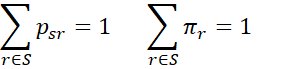
We also require that for any s in S
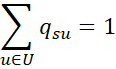
Hidden Markov models are useful in several fields, including speech recognition and genetics.
Topics
- Simulation
- Forward/Backward algorithm
- Viterbi’s algorithm
- Real Statistics support for Viterbi’s algorithm
- Baum-Welch algorithm
- Real Statistics support for Baum-Welch algorithm
- Baum-Welch initialization
Links
References
Wikipedia (2026) Hidden Markov model
https://en.wikipedia.org/wiki/Hidden_Markov_model
Jurafsky, D., Martin, J. H. (2026) Hidden Markov models
https://web.stanford.edu/~jurafsky/slp3/A.pdf