Basic Concepts
Suppose i is a recurrent state (see Connectivity). i is positive recurrent if ni < ∞ and null recurrent if ni = ∞ (see Hitting Probabilities for the definition of ni).
Property 1: In a recurrent class, all states are positive recurrent or all states are null recurrent.
Proof: The proof is similar to that of Property 4 of Connectivity.
Property 2: In a finite closed class, all states are positive recurrent.
Proof: The proof is similar to that of Property 7 of Connectivity.
Based on these properties and related properties in Connectivity, we observe that
- Non-closed classes are transient
- Closed classes in finite Markov chains are positive recurrent
- Closed classes in infinite Markov chains can be transient, null recurrent or positive recurrent.
As we observe in Connectivity, for a one-dimensional random walk with p ≠ .5, all states are transient. When p = .5 all states are recurrent, but as we observe in Random Walks, n0 = ∞, and so all states are null recurrent.
Existence/uniqueness of a stationary distribution
Property 3: For an irreducible Markov chain
- If the chain is positive recurrent, then a unique stationary distribution π exists where πi = 1/ni, where ni is the expected time to return to state i.
- If the chain is null recurrent or transient, then no stationary distribution exists
Even if the Markov chain is not irreducible, Property 3 applies to any communications class that is positive recurrent (and so is closed). The unique stationary distribution applies only to that class.
By Property 7 of Connectivity, a finite, irreducible Markov chain is always positive recurrent, and so Property 3 holds.
Stationary distribution example
Example 1: Find the stationary distribution for the transition matrix in range B2:D4 of Figure 1.
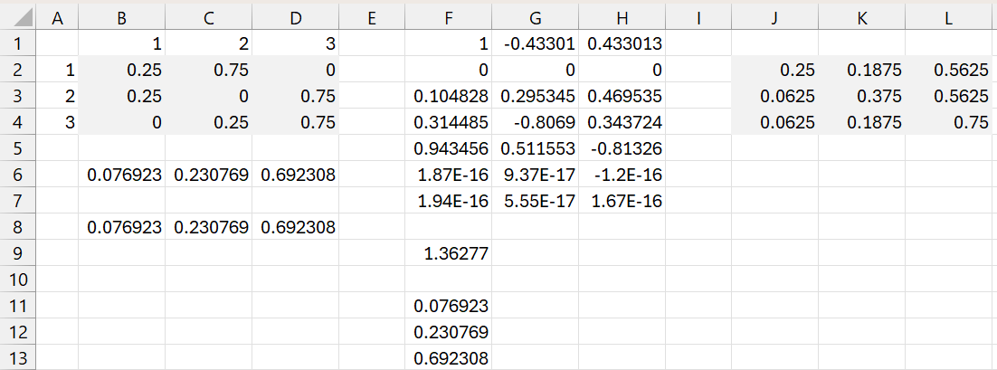
Figure 1 – Stationary distribution
First note that the formula =MPOWER(B2:D4,2) yields the matrix in range J2:L4. Since all the elements in this matrix are positive, per Property 4 of Markov Chain Distributions, there is a unique stationary distribution. This distribution is displayed in range B6:D6, using the approach described in Markov Chain Distributions. We see that the formula =MMULT(B6:D6,B2:D4) yields the results shown in range B8:D8, namely (1/13, 3/13, 9/13),
We note that 1 ↔ 2 ↔ 3, and so the chain is irreducible. Since the Markov chain is finite and there is one communications class, by Property 7 of Connectivity, it is recurrent, and so ti = 1 for i = 1, 2, 3.
We can calculate n11, n22, and n33, as described in Hitting Probabilities.
Calculating n11
k31 = 1 + .25 k21 + .75 k31
.25 k31 = 1 + .25 k21
k31 = 4 + k21
k21 = 1 + .25 k11 + .75 k31 = 1 + .25(0)+ .75(4+k21)
.25 k21 = 1 + 3
k21 = 4(4) = 16
n11 = 1 + .25 k11 + .75 k21 = 1 + .25(0)+ .75(16) = 13
Calculating n22
k12 = 1 + .25 k12 + .75 k22
.75 k12 = 1 + .75(0)
k12 = 4/3
k32 = 1 + .25 k22 + .75 k32
.25 k32 = 1 + .25 k22 = 1 + .25(0) = 1
k32 = 4(1) = 4
n22 = 1 + .25 k12 + .75 k32 = 1 + .25(4/3) + .75(4) = 1 + 1/3 +3 = 13/3 = 4.3333
Calculating n33
k13 = 1 + .25 k13 + .75 k23
.75 k13 = 1 + .75 k23
k13 = 4/3 + k23
k23 = 1 + .25 k13 + .75 k33 = 1 + .25 k13 + .75(0)
= 1 + .25(4/3 + k23)
.75 k23 = 1 + .25(4/3) = 4/3
k23 = (4/3)(4/3) = 16/9
n33 = 1 + .25 k23 + .75 k33 = 1 + .25(16/9) + .75(0) = 1 + 4/9 = 13/9 = 1.4444
Using Property 3
Since this Markov chain is finite, by Property 2, all the states are positive recurrent, and so Property 3 holds.
Clearly, it is much easier to use Property 3 to calculate n11, n22, and n33.

Multiple stationary distributions example
Example 2: Find the stationary distributions for the transition matrix in range B2:E5 of Figure 2.
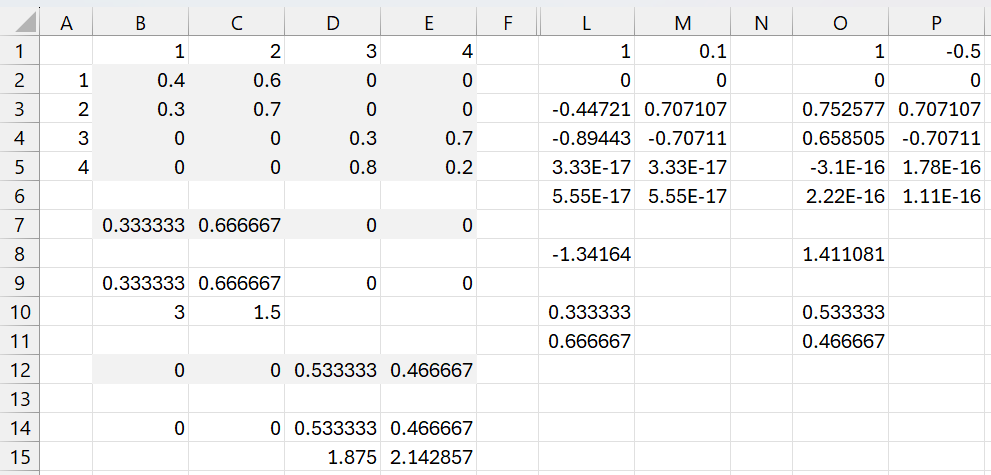
Figure 2 – Two closed classes example
For this example, we see that we have two closed classe {1, 2} and {3, 4}. We can use the eigVECT function on each of the classes (as shown on the right side of the figure) to obtain the distribution shown in range B7:E7 for the first closed class, and the distribution shown in range F8:G9 for the second closed class.
Next, we confirm that each of these is a stationary distribution, using the formulas =MMULT(B7:E7,B2:E5) and =MMULT(B12:E12,B2:E5), as shown in ranges B9:E9 and B14:E14, respectively.
We can also obtain the values n11 = 3 and n22 = 3/2 = 1.5 from the reciprocals of the values in B7 and C7. Similarly, we obtain the values n33 = 15/8 = 1.875 and n44 = 15/7 = 2.142857 from the reciprocals of the values in D12 and E12.
Example with a transient class
Example 3: Find the stationary distribution for the transition matrix in range B2:E5 of Figure 3.
This Markov chain has one transient class {1, 2} and one (positive) recurrent class {3, 4}. Using eigVECT, we see that (0, 0, 8/15, 7/15) is a stationary distribution, as shown B12:F12.
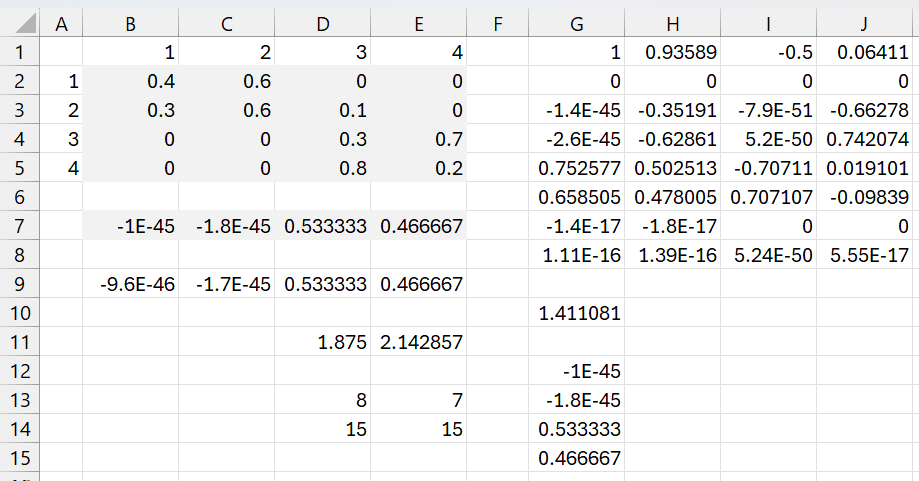
Figure 3 – One transient and one recurrent class
n11 = n22 = ∞ for the transient class, and n33 = 1/.53333 = 1.875 = 15/8 and n44 = 1/.4667 = 2.142857 = 15/7 for the recurrent class.
Examples Workbook
Click here to download the Excel workbook with the examples described on this webpage.
Links
References
Aldridge, M. (2021) Recurrence and transience. Introduction to Markov Processes
https://mpaldridge.github.io/math2750/S09-recurrence-transience.html
Norris, J. (2004) Discrete-time Markov chains. Cambridge University Press
https://www.statslab.cam.ac.uk/~jrn10//Markov/