Integrals are antiderivatives, so any derivative formula can be converted into an integral formula. In particular, we will use facts from Differentiation Techniques, including the following. In each case, we can add a constant term.
Basic Integrals


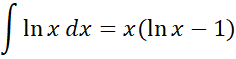
To prove the log integral, we note that

Trig functions



To prove the tan x integral, we note that if cos x > 0 then

While if cos x < 0 then

To prove the sec x integral, we note that if tan x + sec x > 0, then

While if tan x + sec x < 0 , then

Arc trig antiderivatives
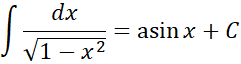
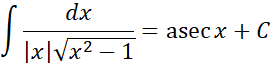
Based on the derivative rules for arc trig functions from Differentiation Techniques, we have
Arc hyperbolic antiderivatives
Based on the derivative rules for arc hyperbolic functions in Differentiation Techniques, we have

We now explore various techniques that are useful in simplifying many integrals. We begin with two more rules that carry over from differentiation.
Sum/Difference Rule

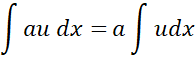
Constant Multiplier Rule
Integration by Substitution
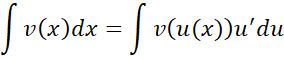
We substitute u = u(x), and so du = u′dx. Thus
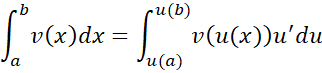
The definite integral version is
Example 1:
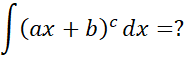
If a ≠ 0, then set u = ax+b, and so du = adx. It now follows that
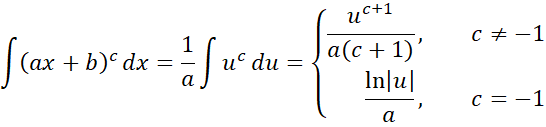 When a ≠ 0 and c ≠ -1

When a ≠ 0 and c = -1
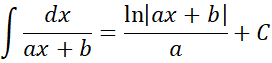
Of course, when a = 0, then

Example 2:
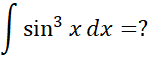
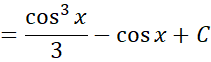
Set u = cos x. Then du = – sin x dx. Thus, dx = – du/sin x, and so


Example 3:
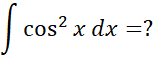
Using trig identities described in Differentiation Techniques, we obtain


More integration techniques
For more techniques, click on either of the following options
Links
References
Bourne, M. (2026) Methods of integration
https://www.intmath.com/methods-integration/
Wikipedia (2026) Integration by substitution
https://en.wikipedia.org/wiki/Integration_by_substitution
Wikipedia (2026) Partial fraction decomposition
https://en.wikipedia.org/wiki/Partial_fraction_decomposition