We describe techniques to evaluate integrals of the form
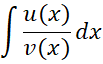
where the numerator and denominator are polynomials. Our goal is to express the integrand as a sum of rational expressions, each of which can be integrated. For cases 1 through 4 below, we assume that the degree of u(x) is less than that of v(x).
Case 1: Denominator is a product of linear expressions
We assume that v(x) can be expressed as a product of linear factors v1(x), …, vk(x). We seek constants a1, …, ak such that the integrand can be expressed as a sum of expressions of the form
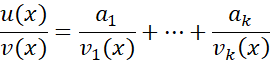
As a result, the integral can be evaluated as a sum of natural logs.
Example 1:
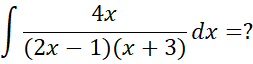
We seek A and B such that

Thus
A(x+3) + B(2x–1) ≡ 4x
Equivalently
(A+2B)x + (3A–B) ≡ 4x
It now follows that
A+2B = 4 3A–B = 0
Solving for A and B results in
A = 4/7 B = 12/7
Hence



We can also find the values for A and B by plugging x = –3 into the equation
A(x+3) + B(2x–1) ≡ 4x
to obtain –7B = –12, i.e. B = 12/7. Similarly, plugging in x = 1/2, we obtain 7A/2 = 2, i.e. A = 4/7.
Example 2:
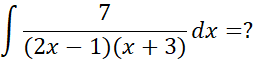
This time
A+2B = 0 3A–B = 7
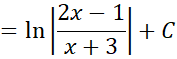
and so A = 2 and B = –1. Hence


Case 2: Denominator is a product of linear expressions with repetitions
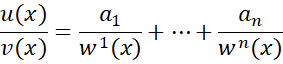
If in case 1, one (or more) of the linear factors is repeated, then the partial fractions used are slightly different. E.g. if v(x) = wn(x) with n > 1, then
Actually, combinations of cases 1 and 2 are also supported.
Example 3:
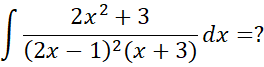
We seek a solution such that

This means that
A(2x–1)(x+3) + B(x+3) + C(2x–1)2 ≡ 2x2 + 3
(2A+4C)x2 + (5A+B–2C)x + (–3A+3B+C) = 2x2 + 3
2A+4C = 2 5A+B–2C = 0 –3A+3B+C = 3
This results in A = 1/43, B = 37/43, and C = 21/43. Hence



Case 3: Denominator is a product of linear and quadratic expressions
If v(x) has a quadratic factor that can’t be factored into linear factors, then the approach is similar to Case 1, except that the numerator for a quadratic factor is now linear and not a constant value.
For example, suppose v(x) can be expressed as a product of linear factors v1(x), …, vk(x) and one quadratic factor w(x). We seek constants a1, …, ak, b, c such that

Note that a quadratic of the form ax2 + bx + c can’t be factored if b2 – 4ac < 0 (i.e. two imaginary roots).
Example 4:
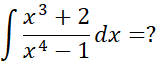
First, we note that
x4 – 1 = (x2 + 1)(x+1)(x – 1)
Thus, we seek A, B, and C such that

(Ax + B)(x + 1)(x – 1) + C(x2 +1)(x – 1) + D(x2 +1)(x + 1) ≡ x3 + 2
(A + C + D) x3 + (B – C + D) x2 + (–A + C + D) x + (–B – C + D) ≡ x3 + 2
A + C + D = 1 B – C + D = 0 –A + C + D = 0 –B – C + D = 2
Solving these equations, we obtain A = 1/2, B = –1, C = –1/4, and D = 3/4. Hence


For the first integral, let u = x2 + 1. Then du = 2x dx, and so

Thus

Case 4: Denominator factorization has a repeated quadratic factor
If in case 3, a quadratic term in v(x) is repeated n times, then the equivalence from case 3 becomes

Example 5:
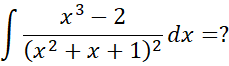

(Ax + B)(x2 + x +1) + (Cx + D) ≡ x3 – 2
A x3 + (A + B) x2 + (A + B + C) x + (B + D) ≡ x3 – 2
A = 1 A + B = 0 A + B + C = 0 B + D = –2
Thus, A = 1, B = –1, C = 0, and D = –1. Hence


where c = 1/2 and a = √3/2. The first of these integrals can be evaluated as described in Example 11 of Quadratic Integrals. The second integral can be evaluated using the quadratic reduction formula (also described in Quadratic Integrals).
Case 5: Degree of u(x) ≥ v(x)
If the degree of u(x) is not less than the degree of v(x), then we need to employ long division to obtain an equivalent expression where the degree of the numerator is less than the degree of the denominator.
Example 6:
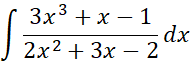
We now show how to use long division to evaluate this integral.


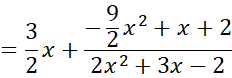

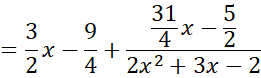
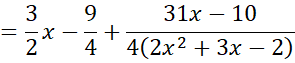
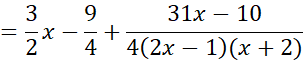
Hence


The remaining integral is evaluated using partial fractions (case 1).
Links
References
Bourne, M. (2026) Methods of integration
https://www.intmath.com/methods-integration/
Wikipedia (2026) Partial fraction decomposition
https://en.wikipedia.org/wiki/Partial_fraction_decomposition