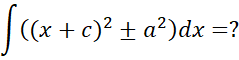
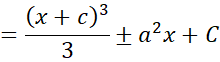
We explore various examples where the integrand contains a quadratic polynomial. We start with the cases where the quadratic takes the form (x + c)2 ± a2.
Examples
Example 1:

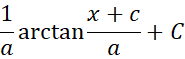
Example 2:
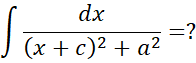
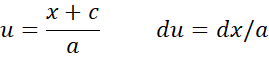

Thus, the integral can be evaluated as follows:
Example 3:
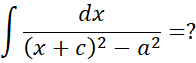
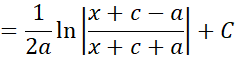
This time, we use partial fractions (see Integration using Partial Fractions)

Thus, the integral can be evaluated as

Example 4:
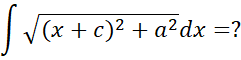




But from the secant reduction formula (see Integration by Parts), we see that


But u = arctan(x+c)/a, which is the angle of a right triangle whose opposite side is x+c and whose adjacent side is a. Thus, the diagonal is the square root of (x+c)2+a2, and so tan u = (x+c)/a and sec u = the diagonal divided by a. Hence





Example 5:
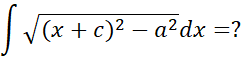
We start with a substitution




We now proceed with integration by parts.





But t = arcsec (x+c)/a, which is the angle of a right triangle whose diagonal is x+c and whose adjacent side is a. Thus, the opposite side is the square root of (x+c)2–a2, and so sec t = (x+c)/a and tan t = the opposite side divided by a. Hence




Example 6:
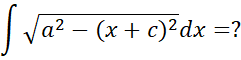



By the cosine reduction formula (see Integration by Parts)

But u = arcsin(x+c)/a, which is the angle of a right triangle whose opposite side is x+c and whose diagonal is a. Thus, the adjacent side is the square root of a2–(x+c)2, and so sin u = (x+c)/a and cos u = the diagonal divided by a. Hence


It now follows that

Example 7:
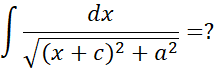



Here, we have used a property about asinh described in Differentiation Techniques.
Example 8:
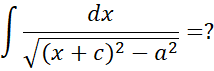



Here, we have used a property about acosh described in Differentiation Techniques.
Quadratic reduction formula
For n > 1

Proof:



By the cosine reduction formula (see Integration by Parts)

But u = arctan(x+c)/a, which is the angle of a right triangle whose opposite side is x+c and whose adjacent side is a. Thus, the diagonal is the square root of (x+c)2+a2, and so sin u = x+c divided by the diagonal and cos u = a divided by the diagonal. Hence


Thus



n = 0, 1, 2
The integral where n = 0 is shown in Example 2.
Example 9: When n = 1, the quadratic reduction formula takes the form


Example 10: When n = 2, the quadratic reduction formula takes the form



Note that when c = 0 and a = 1, this expression takes the following form:

Related cases
Example 11:
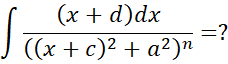
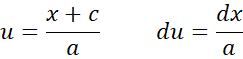
Set u = (x+c)/a, so du = dx/a and x = au–c.


We can evaluate the second integral using the quadratic reduction formula (or Example 2 if n = 1).
We evaluate the first integral using the substitution t = u2+1, dt = 2udu.
If n > 1 then


Hence


If n = 1, then


Note
The integrals with integrands as in the quadratic reduction formula and in Example 11, where the + a2 term is replaced by – a2, can be handled via partial fractions (see Integrals using Partial Fractions) since


Completing the square
A quadratic polynomial can be expressed as
Ax2 + Bx + C
For our purposes, we can assume that A = 1. We consider two cases:
Case 1: 4C ≥ B2. We define c = B/2 and a = square root of C – c2, and note that
(x + c)2 + a2 = x2 + 2cx + c2 + a2 = x2 + Bx + c2 + C – c2 = x2 + Bx + C
Since 4C ≥ B2, it follows that C ≥ B2/4 = c2, and so a is well defined (i.e. the value inside the square root is non-negative).
Case 2: 4C < B2. We define c = B/2 and a = square root of c2 – C, and note that
(x + c)2 – a2 = x2 + 2cx + c2 – a2 = x2 + Bx + c2 – c2 + C = x2 + Bx + C
Since 4C < B2, it follows that C < B2/4 = c2, and so a is well defined (i.e. the value inside the square root is positive).
Conclusion
We see that any quadratic can be expressed as (x + c)2 + a2 or (x + c)2 – a2. Thus, we can evaluate quadratic integrals using the various approaches described previously on this webpage.
Links
References
Bourne, M. (2026) Methods of integration
https://www.intmath.com/methods-integration/
Wikipedia (2026) Integration by substitution
https://en.wikipedia.org/wiki/Integration_by_substitution
Wikipedia (2026) Partial fraction decomposition
https://en.wikipedia.org/wiki/Partial_fraction_decomposition