We describe how to perform integration by parts. This webpage also describes various trigonometric reduction properties and integrals involving quadratic polynomials.
Integration by parts
The basic approach can be summarized as follows:
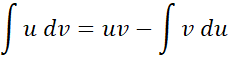
For definite integrals, integration by parts takes the following form:

Proof: By the derivative product rule (see Differentiation Techniques):




Examples
Example 1:
We repeat Substitution Rule Example 2 from Differentiation Techniques
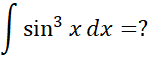
We set u = sin2 x and dv = sin x dx. Thus, du = 2 sin x cos x and v = – cos x. Hence




We note that ∫ sin3 x dx occurs on both sides of the equation. Solving for ∫ sin3 x dx, we obtain

and so



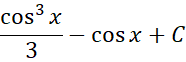
which is the same answer we got in Differentiation Techniques.
Example 2:
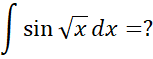
We use the substitution t = √x, and so dt = dx/(2√x) = dx/(2t). Hence

We now set u = t and dv = sin x dx. Thus, du = 2 sin x cos x and v = – cos x. Hence



Thus

Trig reduction properties






In each case, the exponent is reduced by two in each step. If n is odd, then eventually you need to take the integral of a trig function, as described in Trig Integrals of Integration Techniques. If n is even, then eventually you need to take the integral ∫ dx = x + C.
Proofs
Sine property: Proof uses integration by parts, similar to Example 1 above or the secant property next.
Secant property: Proof uses integration by parts as follows.


Thus





It now follows that

and so

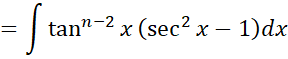
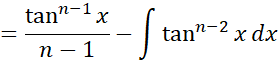
Tangent property: The proof doesn’t rely on integration by parts, but uses a trig identity.



Links
References
Bourne, M. (2026) Methods of integration
https://www.intmath.com/methods-integration/
Wikipedia (2026) Integration by parts
https://en.wikipedia.org/wiki/Integration_by_parts