Basic Concepts
This model is like the M/M/1 with non-preemptive priority queueing, except that there can be multiple servers. As in this model, we define the total arrival rate as λ = λ1 + λ2 + … + λm. As for the M/M/s queueing model, we define τ = λ/μ and ρ = τ/s, where s = the number of servers. A steady state is achieved when ρ < 1.
Properties
Now L, Lq, W, and Wq are defined as for the M/M/1 model with non-preemptive priority queueing except that
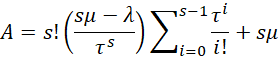

Note that when s = 1 these formulas as equivalent to those for the M/M/1 case.
Example
Example 1: Calculate L, Lq, W, and Wq for the M/M/s queueing model with two servers with two priority classes where the arrival rates and the service rate are as described in column B of Figure 1.
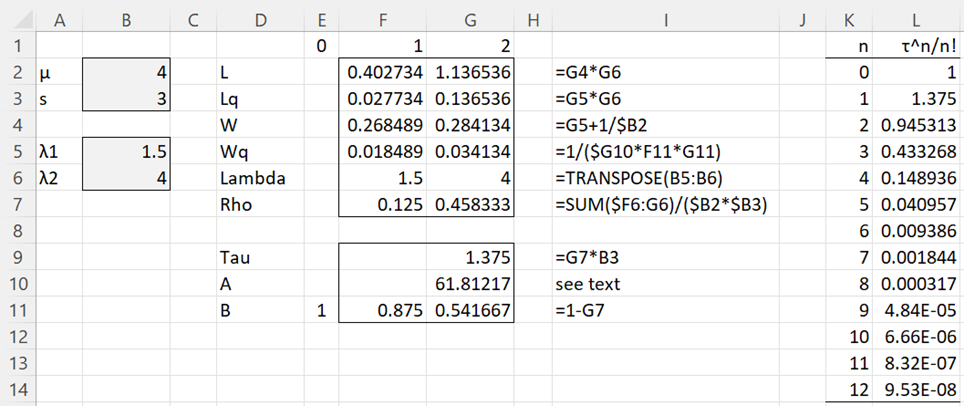
Figure 1 – M/M/s with non-preemptive priority
The results are shown on the right side of Figure 1. Column I displays the formulas in column G. The formula in cell G10 is
=FACT(B3)*(B3*B2-SUM(B5:B6))*SUM(OFFSET(L2,0,0,B3,1))/G9^B3+B3*B2
This formula references the values in column L. Here, cell L2 contains the formula =G$9^K2/FACT(K2), and similarly for the other cells in column L.
Worksheet Functions
Excel Function: The Real Statistics Resource Pack supports the following array function. Here, R1 is a row or column array or cell range that contains the arrival rates for the various priority classes.
MMsP(R1, μ, s, lab): returns an array with L, Lq, W, Wq, ρ for each priority class in an M/M/s non-preemptive priority queueing model with s servers, mean arrival rates in R1, and a mean service rate of μ.
If lab = TRUE (default FALSE) then an extra column of labels is appended to the output.
You can obtain the values in Figure 1 via the array formula =MMsP(B5:B6,B2,B3,TRUE).
Links
Examples Workbook
Click here to download the Excel workbook with the examples described on this webpage.
References
Ross, S. M. (2014) Introduction to probability models, 11th Ed. Academic Press
https://ebin.pub/introduction-to-probability-models-11nbsped-0124079482-9780124079489.html
Sztrik, J. (2021) Basic queueing theory
https://irh.inf.unideb.hu/~jsztrik/education/16/SOR_Main_Angol.pdf
Shores, T. S. (2017) Queueing theory basics and models
No longer available online
Hillier, F. S., Lieberman, G. J. (2010) Introduction to operations research. 9th Ed.