The following figures list the 2-level Taguchi designs supported by Real Statistics.
Designs
Smaller designs:
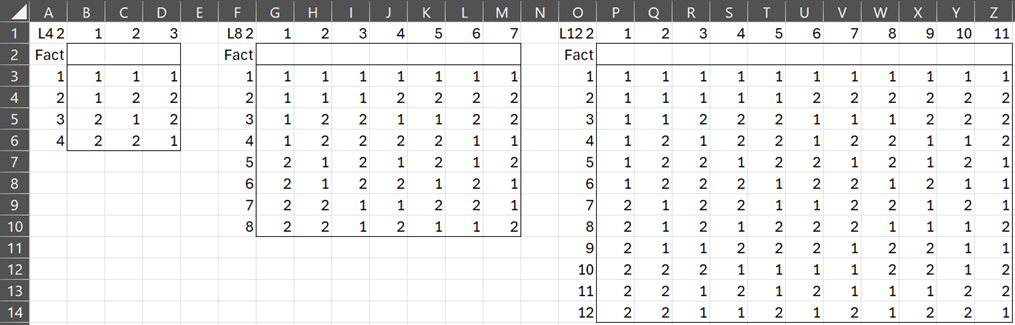
Figure 1 – L4, L8, L12 designs
Larger designs:
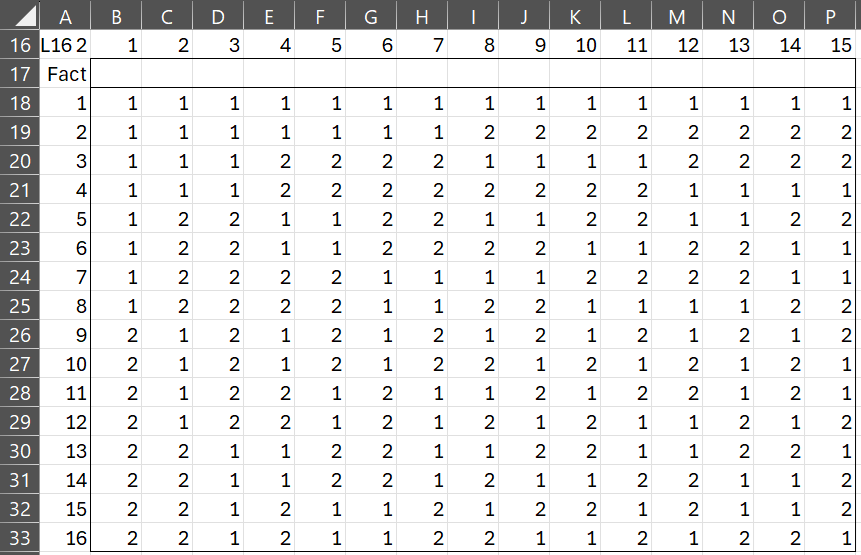
Figure 2 – L16 design
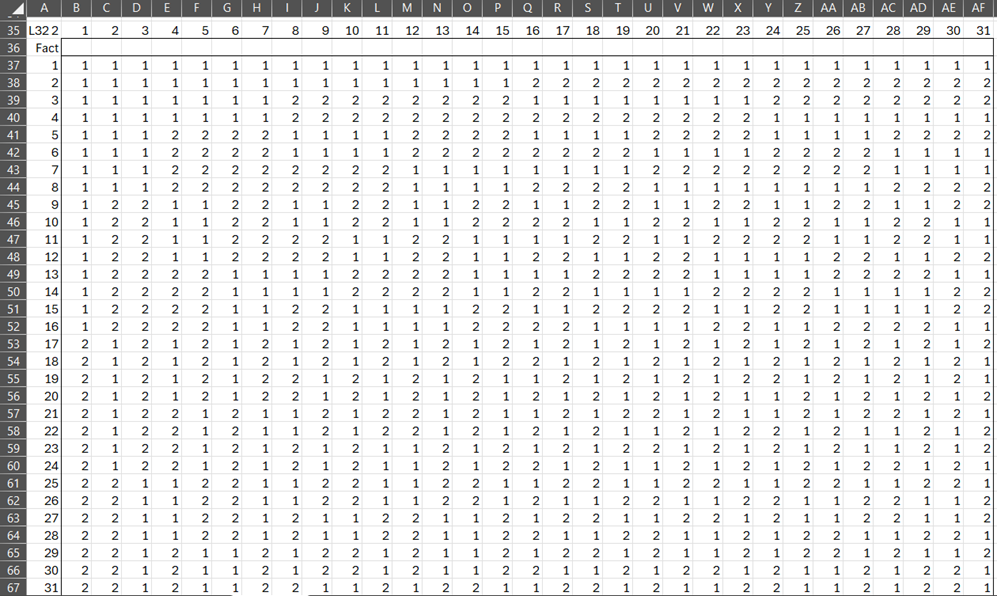
Figure 3 – L32 design
Efficiency of Taguchi designs
A full factorial experiment with 7 factors requires 27 = 128 test runs. Taguchi’s L8 design supports a fractional factorial experiment with only 8 test runs.
Similarly, a full factorial experiment with 15 factors requires 215 = 32,768 test runs. Taguchi’s L16 design supports such an experiment with only 16 test runs.
Interactions
We mentioned in 2-level Taguchi Design that only certain columns can be used for the interaction between two factors. For the 2-level designs shown above, L12 doesn’t permit the interaction of factors. For the other four designs, Figure 4 displays the permissible interactions.
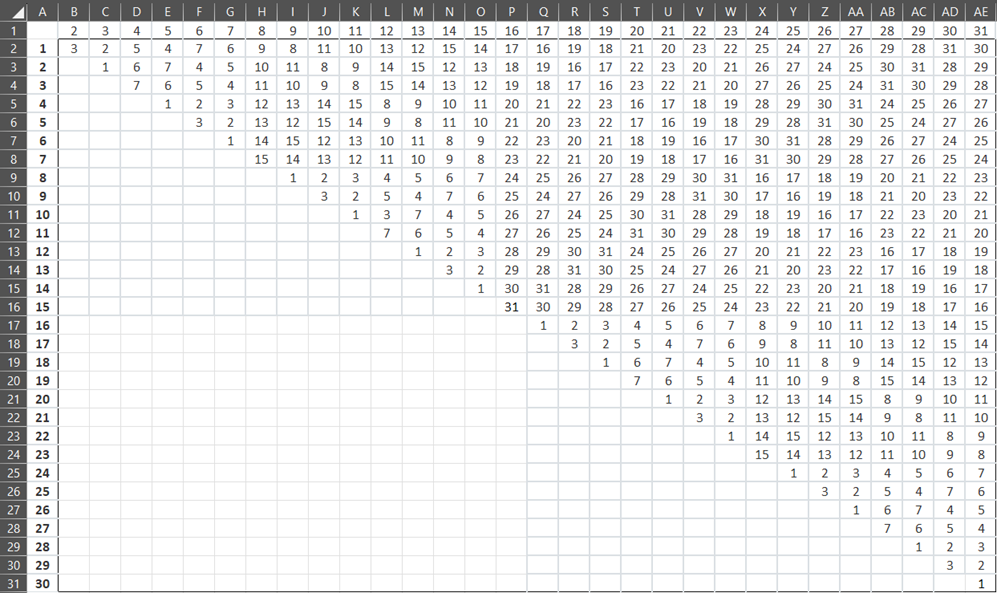
Figure 4 – Interactions for 2-level factors
E.g. if we place main effects factors in columns 3 and 7 of an L8 design, we can only place the interaction between these two factors in column 4 (see cell G4). Similarly, if we place main effects factors in columns 7 and 10, then we can only place the interaction between these two factors in column 13 (see cell J8).
This explains why we placed the interaction AB for Example 1 of 2-level Taguchi Design in column 3 of Figure 2 on that webpage and the interaction BC in column 6.
Links
Examples Workbook
Click here to download the Excel workbook with the examples described on this webpage.
References
Roy, R. K. (2010) A primer on Taguchi method. 2nd ed. Society of Manufacturing Engineers
https://www.scribd.com/document/381615601/288020391-a-Primer-on-the-Taguchi-Method
University of York (2004) Orthogonal arrays (Taguchi designs)
No longer available online
Minitab (2024) Catalogue of Taguchi designs
https://support.minitab.com/en-us/minitab/help-and-how-to/statistical-modeling/doe/supporting-topics/taguchi-designs/catalogue-of-taguchi-designs/