Basic Concepts
The period of a state i of a Markov chain is defined as

where GCD represents the greatest common divisor of a set of integer values (see Coprime Numbers).
If di > 1, then i is periodic. If di = 1, then i is aperiodic.
Examples
Example 1: For the Markov chain with the transition matrix
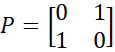
We see that Pn = P for even n, and Pn = I for odd n. Thus p11n = 0 for odd n and p11n = 1 > 0 for even n. This means that d1 = GCD(2, 4, 6, …) = 2. Similarly, d2 = 2.
Similarly, for the transition matrix
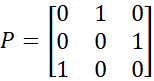
di = 3 for i = 1, 2, 3.
Example 2: For the Gambler’s Ruin Markov chain, 0 and m are aperiodic since they are absorbing states. All the other states are periodic with di = 2. pii1 = pii3 = pii5 = 0. But pii2 = pq > 0, pii4 = C(4,2)p2q2 > 0, etc. Thus, di = GCD(2, 4, 6,…) = 2.
Example 3: The situation is similar for the random walk chain, except that there are no absorbing states. Thus, for any state i, di = 2.
Key Property
Property 1: All states in the same communications class (see Markov Chain Connectivity) have the same periodicity.
Proof: Suppose i ↔ j. Since i → j and j → i, there are k and m such that

By the Chapman-Kolmogorov Theorem (see Markov Chains Basic Concepts)
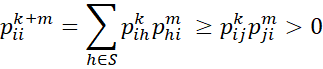
Thus, di | k+m. For any n such that pjjn > 0, by the Chapman-Kolmogorov Theorem is follows that

Thus, di | k+n+m. Since di | k+m and di | k+m+n, we conclude that di | n.
Since dj = GCD(n: pjjn > 0), it follows that di ≤ dj . Swapping the roles of i and j, we can prove that dj ≤ di. Thus, di = dj.
Links
References
Aldridge, M. (2021) Class structure. Introduction to Markov Processes
https://mpaldridge.github.io/math2750/S07-classes.html
Norris, J. (2004) Discrete-time Markov chains. Cambridge University Press
https://www.statslab.cam.ac.uk/~jrn10//Markov/