Introduction
The formula for an ellipse whose center is at the origin is
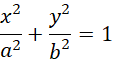
where a and b are the axes of the ellipse. Thus, the formula for the top part of the ellipse is
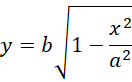
We now show how to calculate the area and perimeter of an ellipse.
Area
You can use the formula A = πab to calculate the area of an ellipse. When r = a = b, this is equivalent to A = πr2, the usual formula for the area of a circle.
We can obtain this formula by using integrals, as follows:
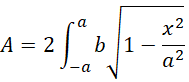
Making the substitution x = a sin θ, we obtain dx = a cos θ dθ. But when x = a, a = a sin θ, and so sin θ = 1, i.e. θ = π/2. Similarly, when x = -a, θ = -π/2. Thus
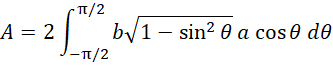
But

and so
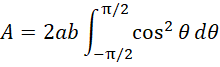
We can now use another property from trigonometry

Hence



Example
Example 1: Find the area of the ellipse with axes of lengths 1 and 2.
Based on the above formula
A = πab = 2π = 2*Pi() = 6.283185307
We can also calculate the area using Real Statistics’ INTEGRAL formula (see Numerical Integration Function). First, we use the Graph y = f(x) data analysis tool, as described in Graphing y = f(x), to draw the top half of the ellipse, as shown in Figure 1. Here, cell A5 contains the formula =B$2*SQRT(1-A4^2/B$1^2).
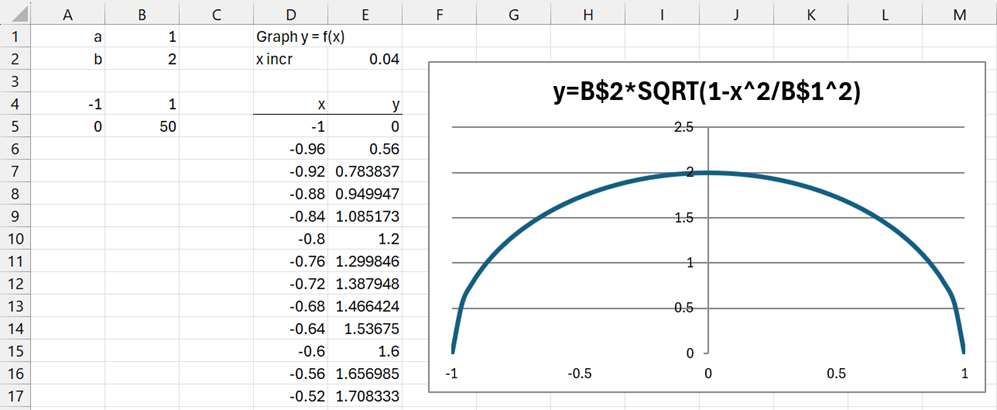
Figure 1 – Graph of the ellipse
The formula =2*INTEGRAL(A5,A4,B4) returns the value 6.283186082, which is pretty close to the value obtained using the formula A = 2*Pi() = 6.283185307, shown above. In fact, the formula =4*INTEGRAL(A5,0,B4) does even better, returning the value 6.283185581. If we increase the number of intervals using the formula =4*INTEGRAL(A5,0,B4,160000), we get the value 6.283185311, which is correct to 8 decimal places.
Perimeter
There is no closed form for the perimeter of an ellipse. Instead, we will use the ARCLENGTH function described in Length of a Curve.
Referring to Figure 1, for an ellipse with a = 1 and b =2, we use the formula =2*ARCLENGTH(A5,A4,B4) to obtain an estimate of 9.688445147, as shown in cell P2 of Figure 2. If we increase the number of intervals, we obtain the estimate of 9.688448119, although more intervals don’t necessarily lead to a better estimate.
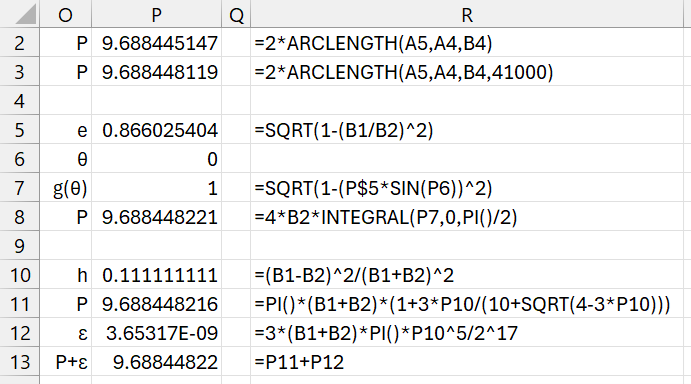
Figure 2 – Perimeter of the ellipse
Another expression for the perimeter of an ellipse is
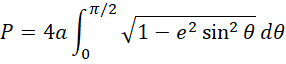
where a ≥ b and e is the eccentricity of the ellipse, namely
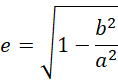
If b > a, then simply reverse the roles of a and b. Using this approach, we obtain an estimate of P = 9.688448221, as shown in cell P8 of Figure 2.
Srinivasa Ramanujan created the following estimate for the perimeter of an ellipse:

where
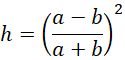
Using his estimate for Example 1, we obtain a perimeter of 9.688448216, as shown in cell P11 of Figure 2.
He later created an improved estimate, namely
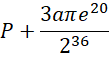
where a is the larger axis, and e is the eccentricity of the ellipse.
A slightly better approximation is
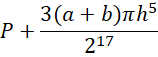
Using this approach, we obtain an estimate for the perimeter of 9.68844822, as shown in cell P13 of Figure 2.
Examples Workbook
Click here to download the Excel workbook with the examples described on this webpage.
Links
References
Wikipedia (2026) Perimeter of an ellipse
https://en.wikipedia.org/wiki/Perimeter_of_an_ellipse
Proof Wiki (2026) Area of ellipse
https://proofwiki.org/wiki/Area_of_Ellipse
Dawkins, P. (2022) Arc length
https://tutorial.math.lamar.edu/classes/calcii/arclength.aspx
Byju’s (2026) Trigonometry formulas
https://byjus.com/maths/trigonometry-formulas/