Basic Concepts
Definition 1: A first-order difference equation takes the form
xn = f(n, xn-1)
for all positive integers n. A solution is a function g(x) such that
xn = g(x0)
By induction on n, such a solution is unique.
Definition 2: A linear first-order difference equation takes the form
xn = f(n, xn-1) = axn-1 + bn
This equation has constant coefficients if bn = b for some b for all n.
Property 1: If a ≠ 0, the unique solution to a linear first-order difference equation can be expressed as
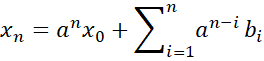
Proof: By induction on n


Note: When a = 0, this is equivalent to
xn = bn
Property 2:
For a linear difference equation with constant coefficient b and a ≠ 1

Proof:


Note: When a = 0, this formula takes the form
xn = anx0 + b = b
When a = 1, then
xn = x0 + b
Equilibrium and Convergence
Definition 3: x0 is an equilibrium of a first-order difference equation if xn = x0 for all n.
Property 3: For any linear difference equation with constant coefficient, where a ≠ 1, x0 = b/(1–a) is a unique equilibrium.
Proof: By Property 2

Definition 4: If for every value of x0, the process xn converges to x*, then the process is said to be globally stable
Property 4: Any linear difference equation with constant coefficient b, where |a| < 1, is globally stable, converging to b/(1–a).
Proof: By Property 2
If |a| < 1, then an → 0 as n → ∞, and so xn → b/(1–a).
Observation: Suppose 0 < a < 1. Then if x0 < b/(1–a), then xn is increasing, while if x0 > b/(1–a), then xn is decreasing. If -1 < a < 0, then xn oscillates since an > 0 for even n and an < 0 for odd n.
If |a| > 1, then xn diverges, and so is not stable. Suppose a > 1. If x0 > b/(1-a), then xn is increasing, while if x0 < b/(1–a), then xn is decreasing. If a < -1, then xn oscillates.
Worksheet Function
The Real Statistics Resource Pack provides the following worksheet function:
DiffEqn1(a, b, x0, n, prop) = xn
If prop = TRUE (default), then Property 2 is used to calculate xn. Otherwise, the function repeatedly uses the formula
xn = axn-1 + b
initially setting xn to x0.
Example
Example 1: Find x20 for the difference equation
xn = –.5xn-1 + 1 x0 = 1
We see that
x0 = 1
x1= –.5x0 + 1 = –.5(1) + 1 = .5
x2= –.5x1 + 1 = –.5(.5) + 1 = .75
x3= –.5x2 + 1 = –.5(.75) + 1 = .625
We would need to continue in this fashion until x20 is reached. Alternatively, we can use

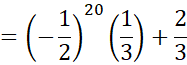
The first term is equal to 9.53674E-07, a small value, and so x20 ≈ 2/3.
Since
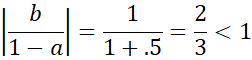
It is not surprising that xn converges to 2/3.
Note too that the formulas =DiffEqn1(-.5,1,1,20) and =DiffEqn1(-.5,1,1,20,FALSE) both take the value .666667.
Second-order difference equations
Click here for information about second-order difference equations.
Examples Workbook
Click here to download the Excel workbook with the examples described on this webpage.
Links
References
Osborne, M. J. (2025) First-order difference equations
https://mjo.osborne.economics.utoronto.ca/index.php/tutorial/index/1/fod/t
Dowling, E. T. (1980) Introduction to mathematical economics. 3rd ed. Schaum’s Outline
https://ugess3.wordpress.com/wp-content/uploads/2015/08/schaum_introduction_to_mathematical_economics.pdf