We now provide a rudimentary example of how to use Factor Analysis.
Example
Example 1: As in Factor Analysis Example, we aim to characterize the traits of a great teacher. For this artificial example, only six criteria were considered, and only 7 students participated in the study. In addition, we want to assess how these criteria influence students’ satisfaction with their teacher (Likert scale 1-5). The data are shown in Figure 1.
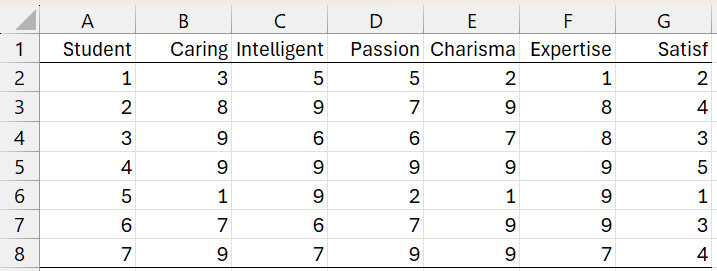
Figure 1 – Teacher data
Using the Regression data analysis tool, we obtained the results shown in Figure 2.
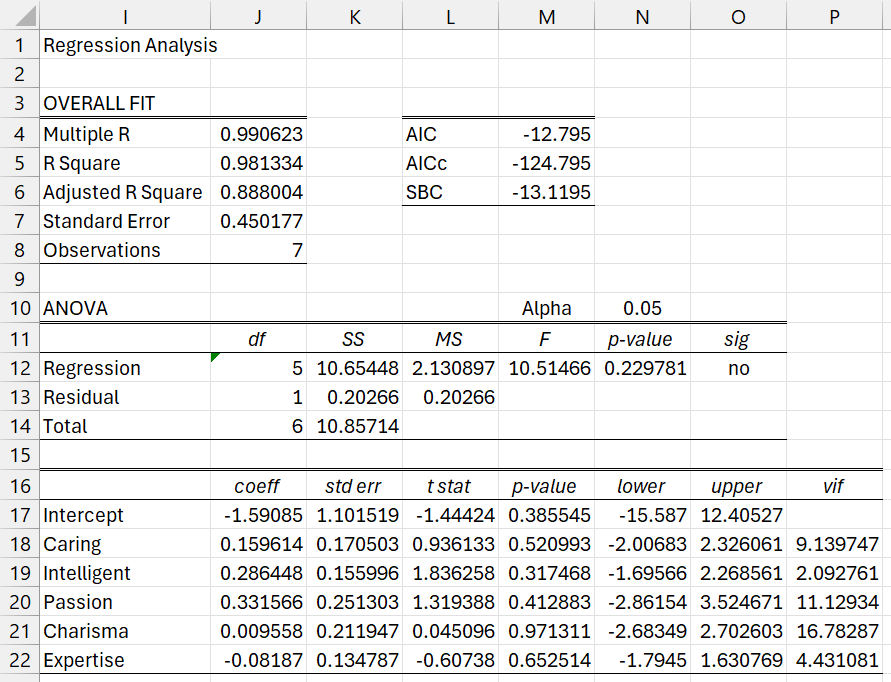
Figure 2 – Regression analysis
We see that none of the 5 criteria is significant in predicting satisfaction. We also observe a high level of multicollinearity (e.g. VIF = 16.78 for Charisma).
Factor Analysis
We plan to use factor analysis to reduce the number of independent variables. Using the Factor Analysis data analysis tool, we obtain a model based on two latent factors. Some of the results are shown in Figure 3 and on the left side of Figure 4.
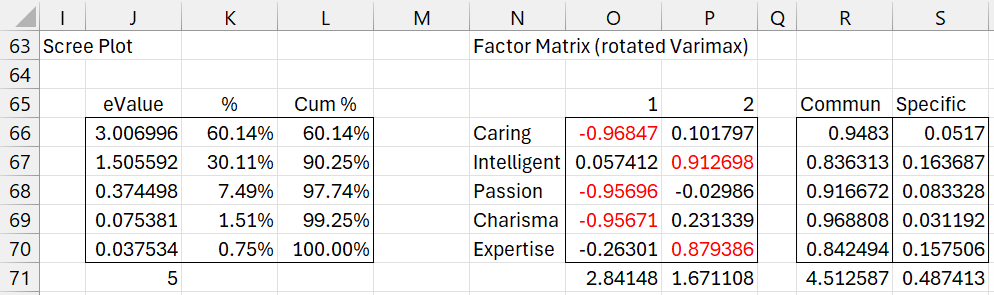
Figure 3 – Factor Analysis (part 1)
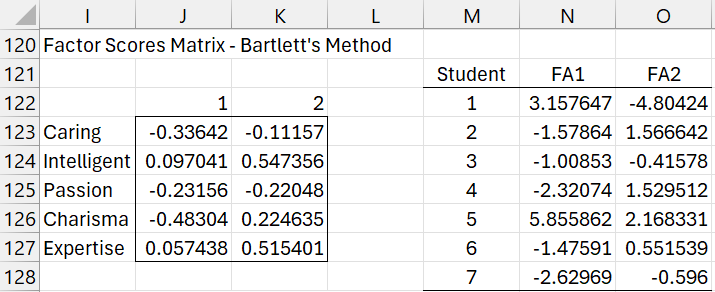
Figure 4 – Factor Analysis (part 2)
We next use the array formula =FAScore(B2:F8,J123:K127) in range N122:O128 to obtain the results shown on the right side of the figure.
Regression using latent factors
Finally, we rerun our regression analysis using the data on the right side of Figure 4 (augmented by the satisfaction scores). The results are displayed in Figure 5.
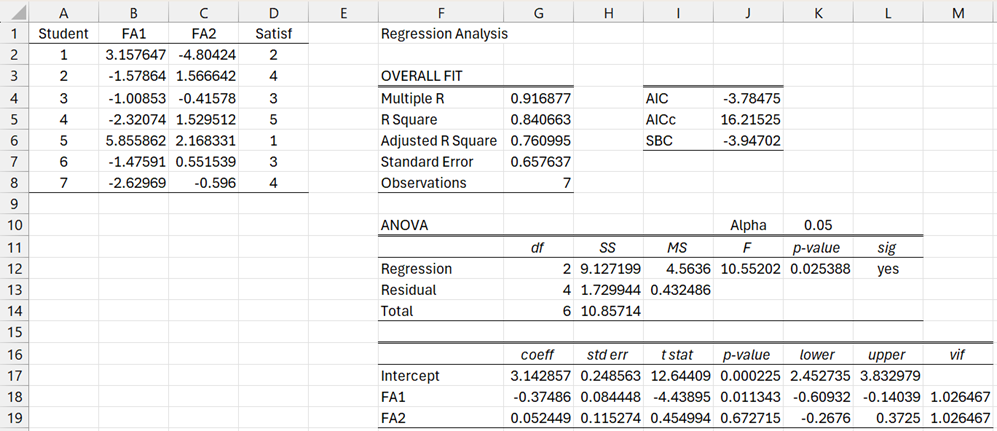
Figure 5 – Regression using latent factors
This approach has eliminated multicollinearity, and we obtain a significant result. We can now predict satisfaction using the formula
Satisf = 3.142857 – 3.7486*FA1 + .052449*FA2
FA1 is significant, while FA2 is not.
Links
Examples Workbook
Click here to download the Excel workbook with the examples described on this webpage.
References
Johnson, R. A., Wichern, D. W. (2007) Applied multivariate statistical analysis. 6th Ed. Pearson
https://mathematics.foi.hr/Applied%20Multivariate%20Statistical%20Analysis%20by%20Johnson%20and%20Wichern.pdf
Rencher, A.C., Christensen, W. F. (2012) Methods of multivariate analysis (3nd Ed). Wiley