Euler’s Formula
Property A (Euler’s Formula): For any complex number z = a + bi

Proof: For any real number z
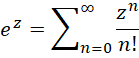
The same formula holds for a complex number z (in fact, this can be viewed as the definition of ez). So, if z = bi, where b is a real number, then

But
i0 = 1, i1 = i, i2 = -1, i3 = –i, i4 =1, i5 = i, etc.
Thus



where we use the infinite sum representations of sin b and cos b for real numbers b.
If z = a + bi, then

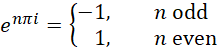
Property B (Euler’s identity)

Proof: By Property A

= 1 ⋅ (-1 + i ⋅ 0) = -1
Actually
Log Function
If z is a complex number, by definition, if ln z = w, then z = ew. Suppose that z = a + bi. As described in Complex Numbers in Polar Format, we can represent z in polar format as

where

Here
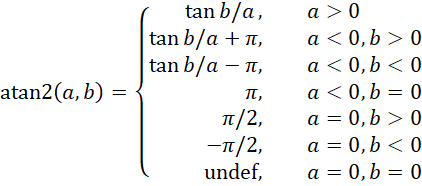
Thus

This proves the following property.
Property C
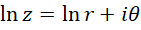
This formula is well defined except for z = 0 since r > 0 otherwise. Note that actually there are infinitely many results, as described below, since

Note that the principal value of the natural log is the one where -π < θ ≤ π, i.e. where n = 0.
Examples
Find ln(-1), ln(i) and ln(-i).
The polar form for -1 is r = 1 and θ = π. Thus
ln(-1) = ln 1 + i(π) = iπ
The polar form for i is r = 1 and θ = π/2. Thus
ln(i) = ln 1 + i(π/2) = iπ/2
The polar form for –i is r = 1 and θ = –π/2. Thus
ln(i) = ln 1 + i(-π/2) = –iπ/2
Power of a real number
Property D: For any complex number z = a + bi and any real number c > 0
cz = ca(cos(b ln c) + sin(b ln c))
Proof: Using Property A and the fact that z ln c = a ln c + (b + ln c)i
cz = (eln c)z = ez ln c = ea ln c(cos(b ln c) + sin(b ln c))
= (e ln c)a ⋅ (cos(b ln c) + sin(b ln c))
=ca(cos(b ln c) + sin(b ln c))
It turns out that this property holds even when c < 0. In this case, however, ln c is a complex number.
Multiple Representations
Since
cos(b+2πn) = cos(b) sin(b+2πn) = sin(b)
for any integer n, from Property A it follows that
ez = ea(cos(b+2πn) + sin(b+2πn))
If ez = w, then w = ln z. Thus, the natural log has infinitely many representations. If z = a + bi is one of these, then so are z = a + (b+2πn)i for any n.
Power function
We now show how to calculate zw for any complex numbers z = a + bi and w = c + di.
As described above, we can express z in polar format as z = reθi. Then, using Property C
zw = (e ln z)w = ew ln z = ew (ln r + θi) = ew ln r ⋅ ewθi = rwewθi
= rc+di e(c+di)θi = rc rdi e-dθ+cθi = rc elnr⋅ di e-dθ ecθi = rce-dθ ⋅ e(d⋅lnr+cθ)i
Now by Property A
zw = rce-dθ ⋅ e(d⋅lnr+cθ)i = rce-dθ (cos φ + i sin φ)
where
φ = d lnr + cθ
Note that all the calculations involve only real numbers.
Also, when w is a real number, i.e. d = 0, then
zw = rc ⋅ ecθi = rc(cos cθ + i sin cθ)
Examples
Find 2i, (-2)i, √i, ii, i1/i, i√2
2i – The polar form for 2 is r = 2 and θ = 0. Thus φ = 1 ln2 + 0 = ln2 ≈ .693147
2i = 20e–0 (cos ln2 + i sin ln2) ≈ cos .693147 + i sin .693147 ≈ .769239 + .638961i
(-2)i – The polar form for -2 is r = 2 and θ = π. Thus φ = 1 ln2 + 0 = ln2 ≈ .693147
(-2)i = 20e–1⋅π (cos ln2 + i sin ln2) ≈ e-π (cos .693147 + i sin .693147)
≈ .043214(.769239 + .638961i) = .033242 + .027612i
√i = i1/2 – The polar form for i is r = 1 and θ = π/2. Thus φ = 0 + (π/2)(1/2) = π/4
√i = 20e–0 (cos π/4 + i sin π/4) = √2/2 + i √2/2 ≈ .707107 + .707107i
ii – The polar form for i is r = 1 and θ = π/2. Thus φ = 0 + 0 = 0
ii = 20e–π/2 (cos 0 + i sin 0) = e–π/2(1 + 0i) = e–π/2 ≈ .20788
i1/i = i(1/i)(i/i) = ii/i^2 = ii(-1) = i-i = 1/ii = 1/e–π/2 = eπ/2 ≈ 4.810477
i√2 – The polar form for i is r = 1 and θ = π/2. Thus φ = 0 + (π/2)√2 ≈ 2.221441
i√2 ≈ 20e–0 (cos 2.221441 + i sin 2.221441) ≈ -.6057 + .795693i
Multiple Representations
Since the power function uses the log function, there are multiple values. In particular
zw = rce-d(θ + 2πn) (cos φ + i sin φ)
where
φ = d lnr + c(θ + 2πn)
nth Root
z1/n = (reiθ)1/n = r1/n eiθ/n
As we saw in Complex Numbers in Polar Format, there are actually n solutions
z1/n = r1/n ei(θ+2πk)/n
for k = 0, 1, …, n-1.
For rational exponents m/n where lcd(m,n) = 1
zm/n = rm/n ei(θ+2πk)m/n
Thus, once again there are n solutions. For all other cases of zw, there are infinitely many solutions.
Square Root
As we have seen previously, for any real number c
zc = rc ⋅ ecθi = rc(cos cθ + i sin cθ)
In particular,
z1/2 = √r (cos θ/2 + i sin θ/2)
As we have noted previously, there are two solutions. Just as for real z, the other solution is the negative of the one given above.
Trig Functions
We define the trigonometric functions for complex numbers so that Euler’s formula holds, namely
ezi = cos z + i sin z
Thus
ezi + e–zi = (cos z + i sin z) + (cos (-z) + i sin (-z))
= (cos z + i sin z) + (cos z – i sin z) = 2 cos z
which means that
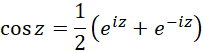 Similarly
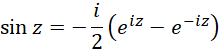
Thus
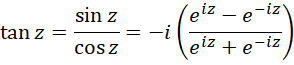
In addition



Similarly

Inverse trig functions



Finally, note that
If w = arctan z then also w + nπ = arctan z, i.e. tan(w+nπ) = z
arctan(z) is not defined for z = nπ/2 for any odd integer n
If w = arccos z then also w + 2πn = arccos z
If w = arcsin z then also w + 2πn = arcsin z
It also turns out that if w = arcsin z, then also π – w = arcsin z
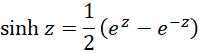
Hyperbolic trig functions



Now if z = a + bi
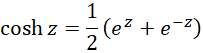


Similarly

Worksheet Functions
Real Statistics Functions: Starting with Rel 9.8, the Real Statistics Resource Pack will provide the following functions for any complex numbers z and w. Some of these functions are already provided prior to Rel 9.8, but with fewer arguments.
| CPOWER(z, w, n, prec) = zw | CSQRT(z) = √z | |
| CSIN(z, prec) = sin(z) | CASIN(z, n, prec, neg) = arcsin(z) | CSINH(z, prec) = sinh(z) |
| CCOS(z, prec) = cos(z) | CACOS(z, n, prec) = arccos(z) | CCOSH(z, prec) = cosh(z) |
| CTAN(z, prec) = tan(z) | CATAN(z, n, prec) = arctan(z) | CTANH(z, prec) = tanh(z) |
| CLN(z, n, prec) = ln z | CEXP(z, prec) = ez | CI() = i |
| CMULT(z, w, prec) = z * w | CDIV(z, w, prec) = z/w |
n takes an integer value and is used for multivalued functions as described above. n defaults to zero.
If the output takes the form a + bi, then if a < prec, then a is reset to 0. Similarly, if b < prec then b is reset to 0. prec defaults to 0.0000000000001.
Note that CSIN(CASIN(z, n)) = z for any z and n, but CASIN(SIN(z, n) is not necessarily equal to z. This is true for the cosine and tangent functions as well.
Finally, as described previously, if w = arcsin(z), then also π – w = arcsin(z). When neg = TRUE (default FALSE), then this form of arcsin is used. Thus, =CASIN(z, n, , TRUE) takes the same value as =CSUB(Pi(),CASIN(z,n)) and CSIN(CASIN(z, n, , neg)) = z for either value of neg.
Links
References
Redcrab (2026) Complex numbers online calculator
https://www.redcrab-software.com/en/Calculator/Complex
Proof Wiki (2026) Definition: inverse tangent/complex
https://proofwiki.org/wiki/Definition:Inverse_Tangent/Complex
Prabhat, A. (2021) Top 10 trigonometric functions for complex numbers in Excel
https://quickexcel.com/trigonometric-functions-complex-numbers/